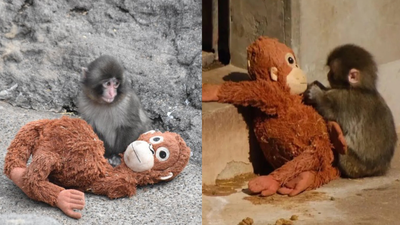
That is part of why so many viewers responded so emotionally. It was not only that Punch looked small and vulnerable. It was that his isolation felt visible in every frame. The plush toy he clung to became especially moving because it seemed to stand in for the comfort he was not receiving from those around him. People projected onto that image what they would naturally feel in a similar situation, fear, sadness, confusion, and a desperate need for reassurance. It is not hard to understand why the story traveled so widely. Even across species, loneliness is something people recognize immediately.
At the center of the early coverage was the fear that Punch might never be accepted at all. Once an animal appears to be rejected within a social group, it is easy for observers to assume the situation will remain fixed. People began following his story with a mixture of sadness and hope, wondering whether the baby monkey who seemed so alone would ever find his place. The emotional response came not just from sympathy, but from uncertainty. His future seemed fragile. There was no guarantee that the distance between him and the others would close.

But time, especially in social groups, can change what initially looks permanent.
Gradually, Punch’s situation began to shift. The change was not sudden or dramatic in a single instant. Instead, it unfolded in the quieter way many meaningful social changes do. Members of the group started allowing him to come closer. The same closeness that once seemed denied to him began to reappear in small but important ways. He was no longer always left at the edge. The distance started shrinking. What had once looked like firm exclusion began softening into cautious tolerance, and then into something more encouraging.
That shift became especially clear when other monkeys began grooming him and including him in their daily interactions. Grooming in primate groups is not a small detail. It is one of the clearest signs of social connection, trust, and acceptance. To see Punch receiving that kind of contact after being so visibly isolated changed the emotional meaning of his story. The young monkey who once seemed abandoned within the group was now beginning to experience the very behaviors that signal belonging.
For those who had followed his earlier struggle, that transformation carried enormous weight. It did not erase the sadness of what came before, but it changed the story from one defined entirely by rejection into one shaped by resilience. Punch was no longer only the baby monkey who had been pushed aside. He had become the monkey who endured that difficult beginning and still found his way into the troop.
That is why his story resonates on a deeper level. It is not simply about an animal being sad and then later appearing happier. It reflects something more universal about adjustment, patience, and the slow pace at which acceptance sometimes arrives. In both human and animal social groups, belonging is not always immediate. Some individuals seem to find their place effortlessly, while others struggle at first and only later become part of the circle. Punch’s journey reflects that harder path, the one where connection is delayed, uncertain, and painfully earned over time.
It also reminds people how easy it is to mistake an early stage of a story for its final outcome. When Punch was first seen alone, many likely assumed the worst. The images were so emotionally powerful that they seemed to tell a complete story by themselves. But social life, whether among humans or animals, is often more fluid than it first appears. Relationships change. Group behavior shifts. Acceptance can emerge after a period of tension or uncertainty. Punch’s later experience shows that what looks fixed in one moment may still be changing beneath the surface.
Part of what made his recovery so meaningful was the contrast with those first images of isolation. A monkey clinging to a plush toy because he had no other obvious source of comfort is unforgettable. But so is the image of that same monkey eventually sitting closer, being groomed, and moving within the group rather than outside it. The emotional arc matters because it reflects movement from exclusion toward connection, from uncertainty toward security.
For the many people who first encountered Punch through heartbreaking footage, the newer reality offers something gentler and stronger than pity. It offers relief. It offers evidence that some stories do not end where the sadness begins. In a world where so many viral animal stories freeze a single painful moment and leave viewers with only that image, Punch’s journey stands out because there is another chapter. There is change. There is progress. There is a sense that the tiny monkey once seen as alone is no longer carrying that same burden in the same way.
That is what makes his story hopeful now. Not because everything was easy, and not because the difficult beginning no longer matters, but because belonging eventually arrived where it once seemed absent. Punch’s experience became more than a story of rejection. It became a story of endurance, adaptation, and the possibility that even after a painful start, connection can still be found.
Today, the young monkey who once captured hearts through visible loneliness is now seen as part of the troop. That shift may seem simple on the surface, but emotionally it carries the kind of resolution people had been wishing for from the start. The comfort he once seemed to seek from a toy has been replaced, at least in part, by real inclusion. For everyone who watched and wondered whether he would ever be accepted, that change is the part that lingers now.
Punch’s story once made people cry because it reflected isolation in one of its clearest forms. Now it stays with people for a different reason. It reminds them that acceptance can come slowly, that social bonds can change, and that even a beginning marked by rejection does not always define the life that follows.