To celebrate World Elephant Day, we wanted to introduce you to someone very special. Meet Shujaa, the hero of Meru!
As you can see, Shujaa is a magnificent bull and one of the most iconic elephants in our Pride of Meru database. With your support, our team is hard at work getting to know every single elephant in our charity’s homeland of Meru National Park. But why is monitoring populations in this way important and how does this work inform our conservation strategies?

An important stronghold, the greater Meru ecosystem is home to around 1,000 elephants. By recognising each one, seeing how they behave and where they go, we can improve our conservation work. Since our Saving Meru’s Giants work began, in 2021, we’ve identified 426 elephants – nearly half the population.
Getting to know Shujaa
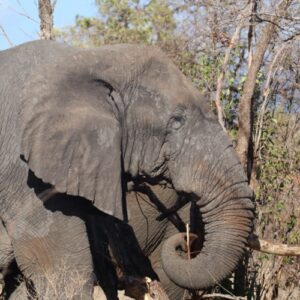
Shujaa is distinctive with one tusk
We estimate mighty Shujaa is over 40 years old. His name, meaning ‘hero’ in Swahili, is a fitting tribute to his strength, resilience and enduring presence in the landscape he calls home. Shujaa is easily recognized by his single left tusk and a distinctive tear on his left ear, features that make him a familiar and well-loved figure to our monitoring team.
Known for his solitary nature, Shujaa is often seen roaming Meru’s Murera plains and Triangle area. To date, Shujaa has been recorded five times, and his bold movements beyond the park boundaries haven’t gone unnoticed. Thanks to our trained Community Conservation Ambassadors – locally employed stewards equipped with skills in elephant monitoring and identification – we’ve been able to track his forays into nearby farmland and respond quickly.
In the Ntukai Community, Shujaa has earned a different name: ‘Kirema’, meaning ‘stubborn’ in the Meru language. This is a nod to his determined crop-raiding behaviour. Yet, despite the damage he has inflicted, the local community has shown remarkable tolerance, extending patience and understanding to him and other elephants alike.
Helping people, saving elephants
Through the Saving Meru’s Giants programme, we’ve supported local farmers by installing beehive fences around crops. Elephants are fearful of bees, so this is an effective, nature-based solution that gently deters elephants, while safeguarding livelihoods AND producing honey to sell.
The project is a quiet triumph of empathy and innovation. It is made possible by the trust built between people and elephants, and by the detailed knowledge we gather about individuals like Shujaa.
Shujaa’s story underscores the importance of robust elephant databases in modern conservation. By monitoring wildlife populations and understanding individual behaviours and movement patterns, we can develop targeted strategies that protect elephants while supporting local communities.
Old habits, new strategies
Once traversing freely following ancient migratory paths, knowing no boundaries, elephants are experiencing fracturing of their habitat due to expanding human settlements. Encounters with people can be dangerous and even deadly for both humans and elephants.
And despite decades of global outcry and efforts to stop the brutal trade in ivory, the threat looms large. These challenges demand more sophisticated, data-driven conservation strategies to ensure the survival of these majestic creatures. This is why our Saving Meru’s Giants team is working so tirelessly to protect Meru’s elephants. Our monitoring team is regularly in the field, identifying and recording elephants’ behaviour and location.
Historically, conservation efforts have relied on monitoring methods such as manual counting, which often produced underestimations and biased results. For many populations, found in more challenging areas, conservationists were ‘working blind’, trying to turn the tide for elephants. Gaps in data hindered effective conservation planning and left elephants vulnerable to ongoing pressures.
Today, however, elephant databases are accelerating conservation efforts by enabling proactive, evidence-based interventions that address complex ecological challenges.
Documenting elephants
Since the Saving Meru’s Giants programme began, we’ve been building a comprehensive elephant database. This robust platform captures critical data on elephant ecology, behaviour, and population dynamics.
Identifying individuals

Meru elephant (c) Blake McGrow
From small calves, just learning about this world and rarely straying far from their mothers, to imposing dominant bulls and wise, weathered matriarchs and who lead and protect their herds, every elephant has a story waiting to be told.
We have carefully photographed and documented each one, capturing not just their physical features, but their personalities, family ties, and life journeys. Every ear notch, every tusk, every interaction is recorded, because each elephant is beautifully, irreplaceably unique.
This rich tapestry of data goes far beyond observation and scientific interest. With each recorded birth, death and movement, we deepen our understanding of elephant behaviour and the challenges they face in an increasingly human-dominated world.
Our work is rooted in empathy and science; a testament to what’s possible when we recognize that every elephant life matters, and that their survival is intertwined with our willingness to listen, learn, and act with care.