
This coin hoard was deposited during the 15th century and contains hundreds of Venetian and Mamluk coins. (Image credit: Tal Rogovski)
Archaeologists have discovered a hoard of gold and silver coins by the remains of a centuries-old synagogue in Israel, near the Sea of Galilee.
The hoard of 364 coins, which was unearthed at the archaeological site of Huqoq (also spelled Yaquq), dates to the 15th century.
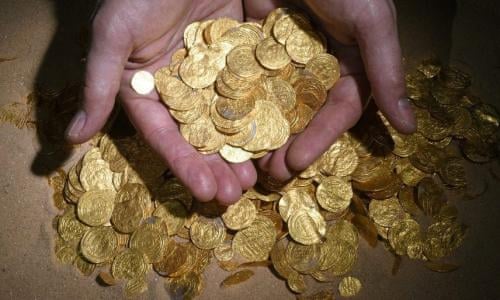
The team found the stash within two jugs under the collapsed wall of the synagogue. Most of the coins are from medieval Venice or the Mamluk sultanate, which controlled the region at the time. It’s unclear why the jugs were filled with coins and left at the site, Robert Kool, a curator in the Israel Antiquities Authority’s coin department, wrote in a paper published in the latest issue of the American Journal of Numismatics.
The earliest of the Venetian coins dates to the time that Francesco Dandolo was doge (leader of Venice), between 1329 and 1339, while the latest Venetian coins date to the reign of Francesco Foscari, from 1423 to 1457, Kool wrote. Many of the Venetian coins have images depicting St. Mark the Evangelist, who is traditionally ascribed as the author of the Gospel of Mark, as well as Latin inscriptions that can be translated as “It is to You, Christ, that this Duchy is entrusted which You govern,” Kool wrote.
During medieval times in the eastern Mediterranean, Venetian coins were widely used as an export currency. “By the end of the fourteenth century [Venetian] ducats were the only European gold currency accepted in Mamluk Egypt and Syria,” Kool wrote in the study


Most of the Mamluk coins in the hoard were minted during the reign of Sultan al-Ashraf Barsbay, from 1422 to 1438, Kool wrote. There are also a few coins from other locations in Southern Europe, such as a silver coin minted during the reign of James I, who was king of Sicily from 1285 to 1295, and even a coin from Serbia.
The “deposition of the hoard occurred sometime during or after 1438-1457,” a date range that is based on analysis of the coins and other archaeological remains, Kool wrote in the paper. Who deposited it, where they got the money from, and why it was left at the synagogue are all unknown.