Yamamoto’s first postseason consecutive complete games in 24 years ease Dodgers’ bullpen, justify $325M

[OSEN=Reporter Cho Hyeong-rae] “He is a classic player who evokes the past.”
LA Dodgers’ Yamamoto Yoshinobu signed the highest-ever pitching contract: 12 years, $325 million (468 billion won). Yet, he has turned this astronomical deal into a ‘generous contract’ by delivering consecutive complete-game wins. If the Dodgers win this year’s World Series and achieve back-to-back championships, even 468 billion won would not feel like a waste.
Yamamoto, on the 26th (Korean time), started at Rogers Centre in Toronto, Ontario, Canada, in Game 2 of the World Series against the Toronto Blue Jays. He pitched 9 innings, threw 105 balls, allowed 4 hits, struck out 8, and gave up 1 run, securing a complete-game victory. Leading the team to a 5-1 win, he avenged the previous day’s (25th) 4-11 defeat, bringing the series record to 1-1 as the Dodgers returned home.
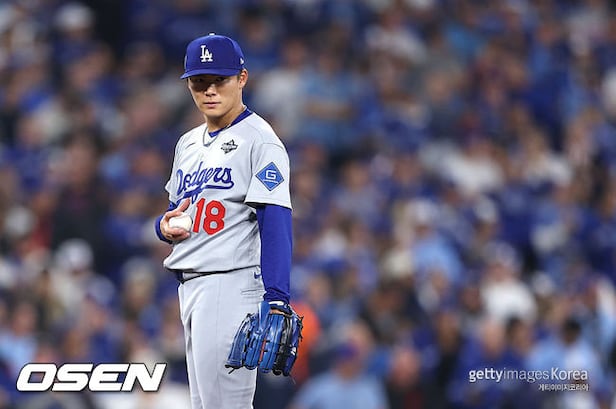
Yamamoto once again took full responsibility from start to finish. On the 15th, in the National League Championship Series against the Milwaukee Brewers, he also pitched 9 innings, threw 111 balls, allowed 3 hits (1 home run), walked 1, struck out 7, and gave up 1 run for a complete-game win. Consecutive complete-game wins in the postseason had not been seen since Curt Schilling of the Arizona Diamondbacks achieved three in a row in 2001—24 years ago. For a Dodgers player, it was the first consecutive complete-game wins in 37 years since Orel Hershiser in 1988.
This year, there were only 26 complete games in the entire MLB regular season, with no pitcher achieving more than two. While starting pitchers remain important, their roles and workloads have been reduced due to data-driven strategies. This trend is especially pronounced in the postseason.

However, Yamamoto defied this trend with a display of complete-game mastery. He did not force the wins; in both games, he completed them with appropriate pitch counts amid natural game flow, showcasing his exceptional ability.
He utilized a variety of pitches: 25 four-seam fastballs (max 97.9 mph/157.6 km/h), 34 splitters, 23 curves, 13 cutters, 6 sliders, and 4 sinkers. He aggressively attacked the strike zone, overwhelming Toronto’s batters.
With Alex Vesia, a key reliever, absent due to family issues, Yamamoto alleviated pressure on the bullpen by finishing the game himself. The bullpen problem was solved by not using them at all.
Manager Dave Roberts evaluated, “It was truly excellent, highly competitive, and special. He was completely focused. I once said, ‘Losing is not an option,’ and that was the look in his eyes tonight.”
This was efficient pitching driven by concentration. Yamamoto had to carry the weight of the team’s 1 loss, the unstable bullpen, and the pressure of the moment. Yet, he overcame it all. Roberts added, “Yamamoto has pitched in massive games in Japan and at the WBC. He has carried the weight of a nation on his shoulders. Pressure comes with that. I believe his ability to perform at a high level in crucial moments, while controlling his heart rate, is part of his DNA.” He continued, “Tonight, Yamamoto could have thrown another 30–40 pitches.”
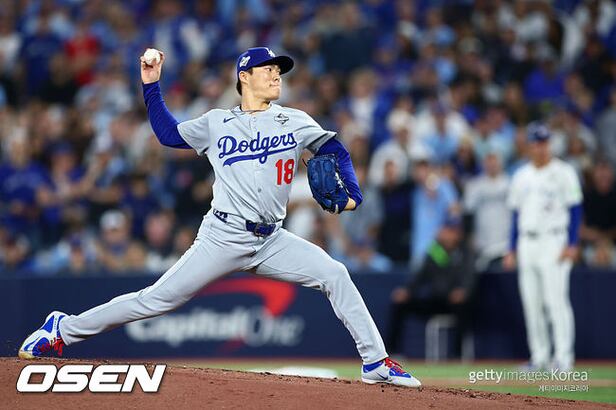
Despite throwing 23 pitches in the first inning, he finished the remaining 8 innings with just 82 pitches—a remarkable ability to manage pitch count. Roberts noted, “After the first inning, I only thought about the sixth. I felt he could at least reach the sixth. The team was aggressive at the plate, but his velocity was good. I sensed he could manage until the sixth, and his pitch count stayed manageable. There was no decline in his mechanics or delivery.”

Yamamoto reflected, “With the high pitch count early on, I didn’t think I could go all the way. But calmly pitching one inning at a time led to a good result. After the fifth, I had thrown 71 pitches. I wasn’t thinking about the ninth then, but focusing on each inning created enough margin by the eighth. That’s why I thought it would be okay. I’m very happy and proud to have contributed to the team with two consecutive complete-game wins.”
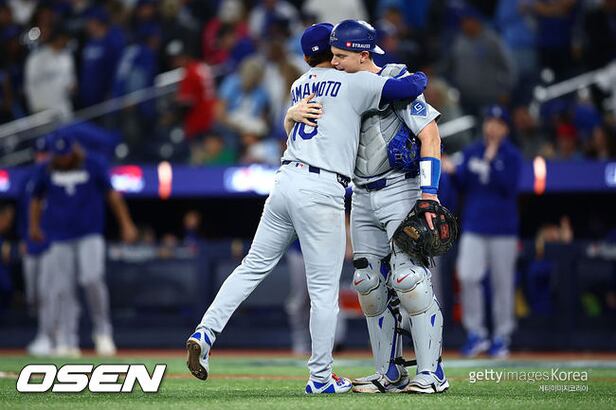
Roberts, recalling the past when complete games were a prized virtue, said, “Yamamoto is a classic player who evokes the past. When he starts, you expect him to finish. As long as I allow it, he will keep pitching, and that’s his intention.”
He emphasized, “I really love it. Having a starting pitcher go 6, 7, 8, or like Yamamoto, 9 innings, is the best option. They must be efficient and have the weapons to face the lineup multiple times—and truly desire it. Yamamoto works tirelessly on his mechanics, preparation, and mental game. Supporting such a player is a joy, and leaving him on the mound feels great,” praising Yamamoto’s complete-game ability.
 Yamamoto can only get another opportunity if the series extends. He could start Game 6 or even pitch out of the bullpen earlier.
Yamamoto, who set an unprecedented record with two consecutive complete-game wins in the postseason, has proven himself a romantic pitcher defying the era—demonstrating that 468 billion won is far from excessive.